
Thaw
Overnight in the fridge
Pull only what you need.
Save up to 12% with our standing order program
Your cart is empty
Shop allThere's more than one standing order in your cart. New items are added to the largest one.

There's more than one standing order in your cart. New items are added to the largest one.
How do you want it?
Have a standing order? Sign in for member pricing
Cart updated ()

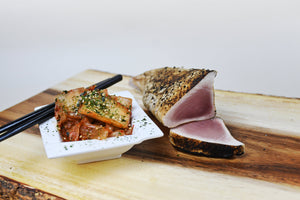
Rich, clean and meaty. Brown it hard, finish it gently, and it stays moist and tender all the way through.
Pull only what you need. Take it out of the vacuum pack, set it on a plate, cover it and thaw it in the fridge.
Seal it in a leakproof bag and sink it in cold water, 20 to 30 minutes. Change the water if it warms. Cook it as soon as it is thawed.
Never on the counter. No microwave, no hot water.
Very hot pan, about 30 sec a side to brown all over. Then into a 200°C/400°F oven for about 10 min, to 70°C/158°F.
Cover with olive oil, garlic and lemon peel. Keep the oil just below a simmer, 12 to 15 min, to 70°C/158°F. Silky, and it flakes into pasta, salads and sandwiches.
Cut into 2 cm steaks. Medium-high heat, 3 to 4 min a side. Oil the fish, not the grill.
Grilled Haidacore Tuna with Montreal Spice and Salsa Verde →Cut into 2 cm strips, roll in the spice mix, sear 2 to 3 min a side until cooked through.
Albacore, Cumin and Lime Spiced Tacos →Albacore is lean. Give it colour in a very hot pan, then let the oven or warm oil take it the rest of the way so it cooks through without drying out.
Sometimes the simplest tricks make the biggest difference. Lightly sprinkle your fish with salt about 10–15 minutes before cooking and let it rest uncovered in the refrigerator. Just before it hits the pan, pat it dry. This quick dry-brine helps season the fish, firms up its texture and sets the stage for a beautifully golden sear.
From Steven Courtney
Here's another little chef's trick. Give your fish a quick bath in lightly salted water before cooking. Dissolve one tablespoon of salt in four cups of cold water, submerge your fish for 10–15 minutes in the refrigerator, then remove and pat thoroughly dry. It's an easy way to season your fish gently and help it retain moisture during cooking.
Want to get the most out of a lemon? It's all about timing. Add a little freshly grated lemon zest before cooking to infuse your fish with those wonderful citrus oils. Then, just before serving, finish with a squeeze of fresh lemon juice. Two simple steps, two different layers of flavour, and one delicious result.
From Steven Courtney
Looking for that beautifully crisp, golden crust without a heavy coating? Reach for rice flour instead of regular wheat flour. A light dusting before pan-frying creates a delicate, crispy exterior while allowing the natural flavour of your fish to shine through. Sometimes the best kitchen secrets are hiding right in your pantry.
From Steven Courtney
There's a reason chefs love finishing fish with butter. Near the end of pan-searing, add a small knob of butter and spoon the melted goodness over your fish as it finishes cooking. This simple technique, known as basting, adds richness, enhances flavour and gives your fish that irresistible restaurant-quality finish. A little goes a long way.
From Chef Julian Bond
Want to give your seafood a little extra personality? Chef Julian Bond has three pantry favourites worth keeping close at hand. A splash of Worcestershire sauce adds savoury depth, pomegranate molasses brings a wonderful sweet-tart kick, and miso paste delivers that irresistible umami richness. Experiment with a little of each. You might discover your next favourite flavour combination.
Don't be shy with the heat! Chef Julian Bond recommends a properly heated pan to develop that beautifully browned, flavourful crust on your fish. The secret is to give each piece a little breathing room. Crowd the pan and the temperature drops, causing your fish to steam rather than sear. Cook in batches if necessary, adjust the heat as you go, and let that golden crust work its magic.
One of the biggest mistakes home cooks make is fussing with their fish. Pat it dry, place it in a properly heated pan and resist the temptation to keep moving it around. Let it cook most of the way on one side before turning it just once to finish. Less handling means better browning, fewer broken fillets and a much happier fish dinner.
From Chef Vibber
Tired of leaving half your beautiful fish stuck to the frying pan? Chef Julian Bond has a clever solution. Place a piece of cooking parchment in your stainless-steel pan, add a little oil and cook your fish on top of the parchment. It creates a barrier that helps prevent sticking, making delicate fillets easier to handle. Just be sure to use parchment rated for the cooking temperature and keep it away from open flames.
Here's a secret to keeping delicate fish beautifully moist. Remember that cooking doesn't stop the moment you turn off the heat. Fish continues to cook gently from its own retained heat, a process chefs call carryover cooking. Take it off the heat as it approaches doneness and let it finish resting briefly. You'll be rewarded with tender, juicy fish instead of an overcooked, dried-out dinner. Check the thickest part with a food thermometer.
From Chef Robert Clark
Troll-caught albacore is one of the most selective tuna fisheries anywhere: one fish, one hook, at a time.
It turns from rosy to opaque and just flakes under a gentle press. On a food thermometer, 70°C/158°F in the thickest part.
Albacore is lean, so long, hard heat dries it. Brown it fast, finish it gently in the oven or in warm oil, and take it off the heat as soon as it reaches 70°C/158°F.
A half loin feeds two generously. A full loin feeds three or four.
Same species, different world. Canned albacore is cooked in the can. This is a frozen loin you cook yourself: roast it, grill it, or poach it in oil.
. Discount code automatically applied at checkout.
Error